


Page 18 - The Plain Truth Spring-Summer 2026
P. 18
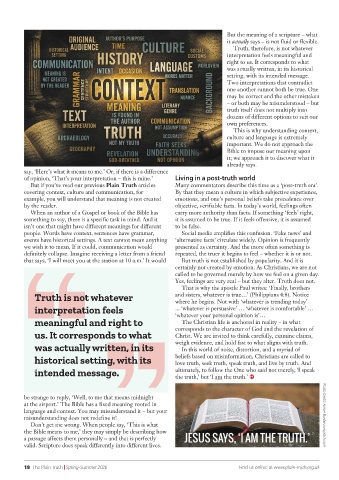
But the meaning of a scripture – what
                                                                                 it actually says – is not fluid or flexible.
                                                                                   Truth, therefore, is not whatever
                                                                                 interpretation feels meaningful and
                                                                                 right to us. It corresponds to what
                                                                                 was actually written, in its historical
                                                                                 setting, with its intended message.
                                                                                 Two interpretations that contradict
                                                                                 one another cannot both be true. One
                                                                                 may be correct and the other mistaken
                                                                                 – or both may be misunderstood – but
                                                                                 truth itself does not multiply into
                                                                                 dozens of different options to suit our
                                                                                 own preferences.
                                                                                   This is why understanding context,
                                                                                 culture and language is extremely
                                                                                 important. We do not approach the
                                                                                 Bible to impose our meaning upon
                                                                                 it; we approach it to discover what it
                                                                                 already says.
         say, ‘Here’s what it means to me.’ Or, if there is a difference
         of opinion, ‘That’s your interpretation – this is mine.’  Living in a post-truth world
            But if you’ve read our previous Plain Truth articles   Many commentators describe this time as a ‘post-truth era’.
         covering context, culture and communication, for      By that they mean a culture in which subjective experience,
         example, you will understand that meaning is not created   emotions, and one’s personal beliefs take precedence over
         by the reader.                                        objective, verifiable facts. In today’s world, feelings often
            When an author of a Gospel or book of the Bible has   carry more authority than facts. If something ‘feels’ right,
         something to say, there is a specific task in mind. And it   it is assumed to be true. If it feels offensive, it is assumed
         isn’t one that might have different meanings for different   to be false.
         people. Words have context, sentences have grammar,     Social media amplifies this confusion. ‘Fake news’ and
         events have historical settings. A text cannot mean anything   ‘alternative facts’ circulate widely. Opinion is frequently
         we wish it to mean. If it could, communication would   presented as certainty. And the more often something is
         definitely collapse. Imagine receiving a letter from a friend   repeated, the truer it begins to feel – whether it is or not.
         that says, ‘I will meet you at the station at 10 a.m.’ It would   But truth is not established by popularity. And it is
                                                               certainly not created by emotion. As Christians, we are not
                                                               called to be governed merely by how we feel on a given day.
                                                               Yes, feelings are very real – but they alter. Truth does not.
                                                                 That is why the apostle Paul writes: ‘Finally, brothers
             Truth is not whatever                             and sisters, whatever is true…’ (Philippians 4:8). Notice
                                                               where he begins. Not with ‘whatever is trending today’
             interpretation feels                              ... ‘whatever is persuasive’ … ‘whatever is comfortable’ …
                                                               ‘whatever your personal opinion is’…
             meaningful and right to                             The Christian life is anchored in reality – in what

             us. It corresponds to what                        corresponds to the character of God and the revelation of
                                                               Christ. We are invited to think carefully, examine claims,
             was actually written, in its                      weigh evidence, and hold fast to what aligns with truth.
                                                                 In this world of noise, distortion, and a myriad of
             historical setting, with its                      beliefs based on misinformation, Christians are called to
                                                               love truth, seek truth, speak truth, and live by truth. And
             intended message.                                 ultimately, to follow the One who said not merely, ‘I speak
                                                               the truth,’ but ‘I am the truth.’ !


         be strange to reply, ‘Well, to me that means midnight
         at the airport.’ The Bible has a fixed meaning rooted in
         language and context. You may misunderstand it – but your
         misunderstanding does not redefine it!                                                                    Photo Credit: Aaron Burden/unsplash.com
            Don’t get me wrong. When people say, ‘This is what
         the Bible means to me,’ they may simply be describing how
         a passage affects them personally – and that is perfectly
         valid. Scripture does speak differently into different lives.


         18  The Plain Truth   Spring-Summer 2026                                    Find us online at www.plain-truth.org.uk

