


Page 17 - The Plain Truth Spring-Summer 2026
P. 17
opposite of what Danish philosopher Søren Kierkegaard
        believed. He stated that truth is subjective. To Kierkegaard
        truth is a personal thing – something we are, not
        something we have.

        Three simple ways to understand truth
        So how can we understand the meaning of ‘truth’ that
        meets with what Jesus said to Pilate? Philosophers often
        describe truth in three straightforward ways:

          1. Truth corresponds to reality
        A statement is true if it matches what actually exists. If I say,
        ‘It is raining,’ that statement is true if – and only if – rain is
        actually falling.

          2. Truth matches its object
        A belief is true if it accurately reflects the thing it describes.
          3. Truth is telling it like it is

        Not exaggeration. Not distortion. Not ‘spin’. It is reality that
        is described honestly.

          All three definitions point in the same direction: truth is
        not created by our feelings. It does not bend to preference.
        It does not change just because we might dislike it.
          In modern culture, we often hear phrases such as
        ‘my truth’ or ‘your truth’. These usually mean personal
        experience or perspective.                           say. Nowhere does he say, ‘I teach the truth.’ Nor does he
          Of course, experiences matter. But experience alone   say, ‘I point to the truth.’ He says, ‘I am the truth.’
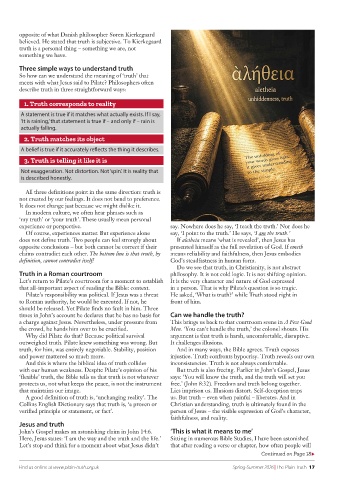
        does not define truth. Two people can feel strongly about   If aletheia means ‘what is revealed’, then Jesus has
        opposite conclusions – but both cannot be correct if their   presented himself as the full revelation of God. If emeth
        claims contradict each other. The bottom line is that truth, by   means reliability and faithfulness, then Jesus embodies
        definition, cannot contradict itself!                God’s steadfastness in human form.
                                                               Do we see that truth, in Christianity, is not abstract
        Truth in a Roman courtroom                           philosophy. It is not cold logic. It is not shifting opinion.
        Let’s return to Pilate’s courtroom for a moment to establish  It is the very character and nature of God expressed
        that all-important aspect of reading the Bible: context.  in a person. That is why Pilate’s question is so tragic.
          Pilate’s responsibility was political. If Jesus was a threat   He asked, ‘What is truth?’ while Truth stood right in
        to Roman authority, he would be executed. If not, he   front of him.
        should be released. Yet Pilate finds no fault in him. Three
        times in John’s account he declares that he has no basis for   Can we handle the truth?
        a charge against Jesus. Nevertheless, under pressure from   This brings us back to that courtroom scene in A Few Good
        the crowd, he hands him over to be crucified.        Men. ‘You can’t handle the truth,’ the colonel shouts. His
          Why did Pilate do that? Because political survival   argument is that truth is harsh, uncomfortable, disruptive.
        outweighed truth. Pilate knew something was wrong. But   It challenges illusions.
        truth, for him, was entirely negotiable. Stability, position   And in many ways, the Bible agrees. Truth exposes
        and power mattered so much more.                     injustice. Truth confronts hypocrisy. Truth reveals our own
          And this is where the biblical idea of truth collides   inconsistencies. Truth is not always comfortable.
        with our human weakness. Despite Pilate’s opinion of his   But truth is also freeing. Earlier in John’s Gospel, Jesus
        ‘flexible’ truth, the Bible tells us that truth is not whatever   says: ‘You will know the truth, and the truth will set you
        protects us, not what keeps the peace, is not the instrument   free.’ (John 8:32). Freedom and truth belong together.
        that maintains our image.                            Lies imprison us. Illusions distort. Self-deception traps
          A good definition of truth is, ‘unchanging reality’. The   us. But truth – even when painful – liberates. And in
        Collins English Dictionary says that truth is, ‘a proven or   Christian understanding, truth is ultimately found in the
        verified principle or statement, or fact’.           person of Jesus – the visible expression of God’s character,
                                                             faithfulness, and reality.
        Jesus and truth
        John’s Gospel makes an astonishing claim in John 14:6.   ‘This is what it means to me’
        Here, Jesus states: ‘I am the way and the truth and the life.’   Sitting in numerous Bible Studies, I have been astonished
        Let’s stop and think for a moment about what Jesus didn’t   that after reading a verse or chapter, how often people will
                                                                                             Continued on Page 18̬

        Find us online at www.plain-truth.org.uk                                   Spring-Summer 2026   The Plain Truth 17

